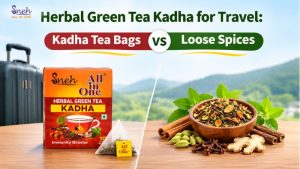
Herbal Green Tea Kadha for Travel: Kadha Tea Bags vs Loose Spices
Written by: Sneh All In One Editorial Team Herbal Green Tea Kadha is a ready-to-brew tea bag blend made with green tea extract and traditional

Written by: Sneh All In One Editorial Team
Herbal Green Tea Kadha is a ready-to-brew tea bag blend made with green tea extract and traditional herbs and spices.
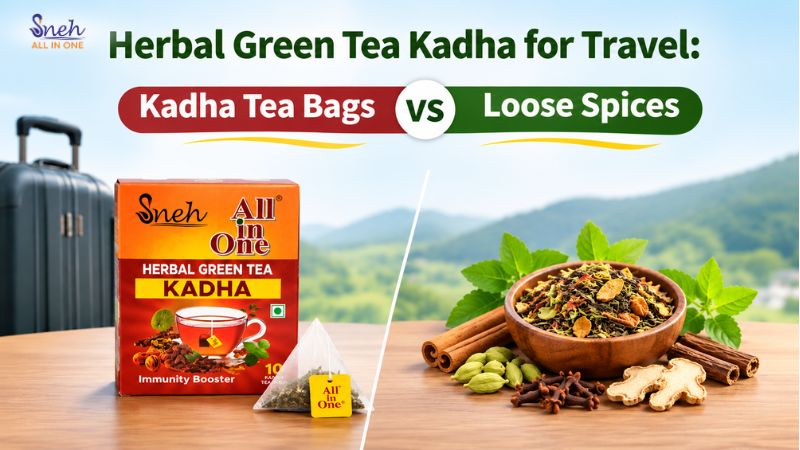
For most trips, kadha tea bags are more practical than loose spices because they are pre-portioned, compact and do not require measuring or straining. Loose spices are better when you want to customise a recipe or prepare kadha from scratch.
Yes, for most trips. One 2.5 g tea bag can be prepared with 100 ml of hot water and steeped for 4–5 minutes. The 25-bag box is listed at ₹210, which works out to ₹8.40 per tea bag.
Monsoon and winter journeys can involve unpredictable weather, traffic delays, cold mornings and limited access to familiar food and beverage options. Carrying a few tea bags can help you maintain your preferred beverage routine without packing separate herbs and spices.
The requirements also differ slightly between seasons.
Rain and unexpected travel delays can make food and beverage preparation more challenging.
Individually packed tea bags are easy to organise in a travel pouch. You can prepare a warm drink when clean hot water is available, whether you are waiting at a railway station, staying in a hotel or taking a break during a road trip.
Cold mornings and chilly evenings often make warm beverages more appealing. A ready-to-brew winter kadha tea bag can be useful during early-morning departures, long road journeys and trips to hill stations.
Pack the tea bags where you can reach them easily, so you can prepare a warm drink during a suitable break.
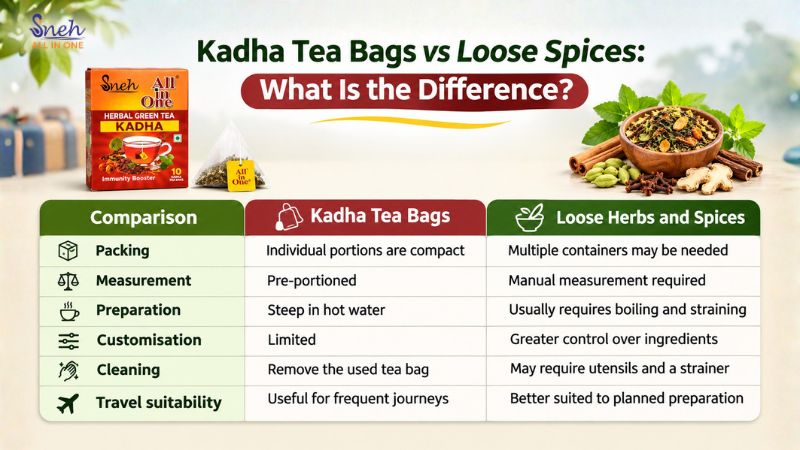
Both formats can be used to prepare a traditional-style herbal beverage, but they serve different needs.
Comparison | Kadha Tea Bags | Loose Herbs and Spices |
Packing | Individual portions are compact | Multiple containers may be needed |
Measurement | Pre-portioned | Manual measurement required |
Preparation | Steep in hot water | Usually requires boiling and straining |
Customisation | Limited | Greater control over ingredients |
Cleaning | Remove the used tea bag | May require utensils and a strainer |
Travel suitability | Useful for frequent journeys | Better suited to planned preparation |
Tea bags are more practical when packing space and preparation time matter. Loose ingredients are preferable when you want to customise the recipe or control the proportions yourself.
A travel kit already contains several essentials, including chargers, documents, toiletries, medicines and clothing. Carrying multiple jars of spices can add unnecessary bulk.
Individual tea bags are easier to arrange in a small pouch or compartment of your backpack. Keep them in their original packaging to retain the product information.
Monsoon humidity can affect the aroma and quality of improperly stored tea products.
Keep your tea bags in a sealed, dry pouch and away from direct sunlight, heat and moisture. Check the best-before or expiry information and follow the storage conditions printed on the package.
A clean cup makes it easier to prepare your drink when you have access to safe hot water. A small insulated flask can also be useful on road trips and during long commutes.
For air travel, carry the flask empty through security and refill it after screening. Do not assume that you can carry a filled flask or hot beverage through the security checkpoint.
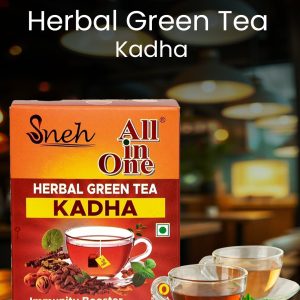
Our Herbal Green Tea Kadha combines green tea extract with traditional herbs and spices in a ready-to-brew tea bag format.
Ingredients:
The blend contains 16 ingredients, plus stevia in select variants.
Stevia is not a standard ingredient across all variants. It is a sweetener, but its presence alone does not establish that a product is sugar-free. Check the nutritional declaration and ingredients of the specific variant before making a sugar-related dietary decision.
Black salt contributes to overall sodium intake. People following a sodium-restricted diet should check the product’s nutritional information.
Our Herbal Green Tea Kadha is available in different pack sizes. The 25-tea-bag box is listed at ₹210, which works out to ₹8.40 per tea bag.
Pack option | Pack contents | Listed price | Price per tea bag |
Single box | 10 tea bags | ₹90 | ₹9.00 |
Single box | 25 tea bags, 2.5 g each | ₹210 | ₹8.40 |
Combo pack | 4 boxes of 25 tea bags each | ₹840 | ₹8.40 |
The four-box combo contains 100 tea bags in total. At ₹840, the cost remains ₹8.40 per tea bag, so it does not offer a lower per-bag price than buying four individual 25-bag boxes at ₹210 each.
You can check the official Sneh product listing for available pack options and current prices. The Amazon combo listing is another option. Prices and availability may change, so check the listing before ordering.
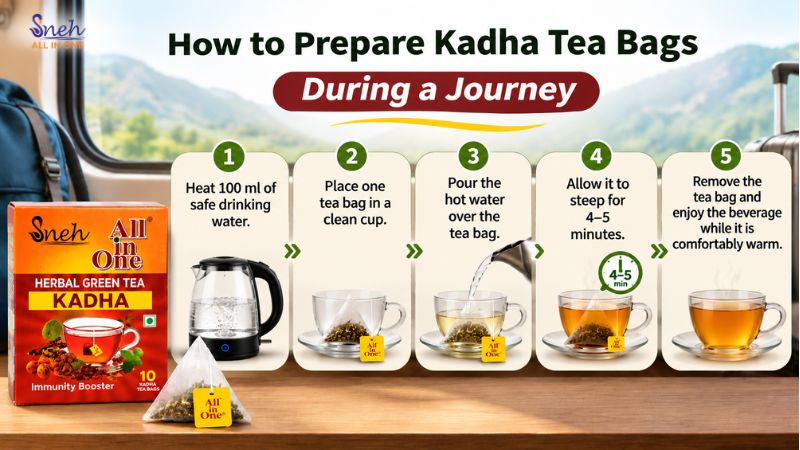
You do not need to boil loose spices or carry a separate strainer to prepare a tea bag.
Follow these steps:
A hotel kettle can be useful if the water and kettle are clean. During train journeys, use hot drinking water from a reliable source rather than assuming that all pantry water is suitable for consumption.
For drivers, prepare the drink during a safe parking break. Never handle boiling water or prepare a beverage while driving.
Dry tea bags are generally easier to pack than prepared beverages. However, passengers should follow the airline’s baggage rules and airport security instructions. Security staff have the final say on whether an item can be carried.
For domestic and international flights, check the airline’s current cabin baggage rules. For example, Air India’s cabin baggage guidelines restrict liquids, aerosols and gels in cabin baggage to containers of 100 ml or less, subject to applicable exceptions.
The Bureau of Civil Aviation Security (BCAS) passenger FAQ explains that carry-on and checked baggage have different restrictions and that baggage is screened and may be hand-searched. Delhi Airport’s security guidelines specify that liquids, aerosols and gels must be in containers with a maximum capacity of 100 ml. Multiple containers, up to a total of 1,000 ml, must be placed in a transparent, resealable plastic bag.
These liquid restrictions apply to prepared beverages. Do not assume that you can carry a large bottle of hot water through airport security.
For train journeys, pack the tea bags in your personal luggage and use safe drinking water when preparing them. Keep the packaging accessible.
A natural ingredient does not automatically make a beverage suitable for everyone. People with existing medical conditions, those taking regular medication, pregnant or breastfeeding individuals, and people with known ingredient allergies should review the complete ingredient list with a qualified healthcare professional.
These considerations are not an exhaustive list of possible interactions. The actual risk also depends on ingredient quantities, frequency of consumption and individual health circumstances.
Do not use kadha as a substitute for prescribed medicines, medical treatment or vaccinations.
Yes. Our Herbal Green Tea Kadha contains green tea extract, which naturally contains caffeine. We have not established a caffeine quantity per cup. People who are sensitive to caffeine should consider their total daily intake from all sources.
There is no established guidance for this blend. Caffeine and spices can upset some people’s stomachs, so if you are sensitive, have it with food.
You can adjust the taste with honey or lemon if they suit your dietary preferences. Add them after brewing and once the drink has cooled slightly. Honey should never be given to infants under 12 months.
Do not assume that an adult herbal blend is suitable for children. This product contains green tea extract and several herbal ingredients. Consult a paediatrician before offering it to a child.
One tea bag is prepared with 100 ml of hot water and steeped for 4–5 minutes. This is a preparation instruction, not a recommended daily intake. The available product information does not establish a universal daily limit for this blend. Ask a healthcare professional if you plan to consume it regularly, particularly if you have a medical condition or take medication.
Check the best-before or expiry date printed on the product packaging. The shelf life can vary by product and batch, so use the date on the pack rather than assuming a fixed shelf life.
They serve different taste preferences. Kadha tea bags combine green tea extract with herbs and spices such as tulsi, mulethi, ginger, cinnamon and black pepper. Plain green tea bags primarily contain green tea. Choose according to the ingredients and flavour profile you prefer.
Dry tea bags can generally be packed in cabin or checked baggage, subject to the airline’s baggage allowance and security screening. Liquid restrictions apply to prepared beverages, so check the current airline and airport rules before travelling.

Written by: Sneh All In One Editorial Team Herbal Green Tea Kadha is a ready-to-brew tea bag blend made with green tea extract and traditional

Sitting at a desk for long hours can contribute to digestive discomfort, including bloating, gas, constipation and acidity. Irregular meals, rushed eating, low fluid intake

To beat the 3 PM slump without another cup of coffee, drink water, take a 5–15-minute walking break, choose a balanced snack, and consider a