Can You Drink Herbal Tea During Intermittent Fasting? A Complete Guide to Zero-Calorie Sips
Written by: SNEH All In One Editorial Team Yes, you can drink plain, unsweetened herbal tea during intermittent fasting. A simple brewed herbal tea contains

Written by: SNEH All In One Editorial Team
If your throat feels scratchy every November, you’re not imagining it. Here is what smog does to your breathing, and what actually helps.
To protect your lungs from air pollution, check the AQI, limit outdoor exposure, wear a well-fitted N95 mask when needed and keep indoor air clean. High pollution irritates the nose, throat and airways, and fine PM2.5 particles can travel deep into the lungs.
Air pollution affects the respiratory system when harmful gases and tiny airborne particles enter the body through breathing. These pollutants can irritate the nose, throat and airways, leading to coughing, throat discomfort, wheezing, chest tightness and difficulty breathing.
The impact depends on the type of pollutant, its concentration, the duration of exposure and a person’s existing health conditions.
Some common air pollutants include:
Fine particulate matter is a particular concern because smaller particles can penetrate deeper into the respiratory system. The World Health Organization (WHO) identifies air pollution as an important risk to respiratory and cardiovascular health.
The Air Quality Index (AQI) is a measurement system that communicates outdoor air pollution levels through a number and a category. In India, the Central Pollution Control Board (CPCB) uses six categories to explain the general health impact of air quality.
AQI category | AQI range | General health impact | What to do |
Good | 0–50 | Minimal impact | No special precautions. |
Satisfactory | 51–100 | Minor breathing discomfort may occur in sensitive individuals. | Sensitive people should do less prolonged or strenuous outdoor activity. |
Moderate | 101–200 | People with lung or heart conditions, children and older adults may experience discomfort. | Everyone should do less prolonged or strenuous outdoor activity. Sensitive people should avoid it. |
Poor | 201–300 | Prolonged exposure may cause breathing discomfort. | Avoid outdoor exertion. Sensitive people should avoid outdoor physical activity. |
Very Poor | 301–400 | Prolonged exposure may increase the risk of respiratory illness. | Avoid outdoor physical activity, especially in the morning and late evening. Sensitive people should stay indoors and keep activity low. |
Severe | 401–500 | Health effects may occur even in healthy people, with greater risks for vulnerable groups. | Avoid outdoor physical activity. Sensitive people should stay indoors and keep activity low. |
AQI categories: CPCB. “What to do” column adapted from the MoHFW/NCDC Health Advisory on Air Pollution (2022).
Before going for a walk, exercising outdoors or planning a long commute, check the latest AQI for your area through the CPCB National AQI dashboard. Air quality can vary between monitoring locations, even within the same city.
India’s National Ambient Air Quality Standards (NAAQS), notified in 2009, and the WHO’s global air quality guidelines use different recommended limits for PM2.5.
Standard | Annual PM2.5 level | 24-hour PM2.5 level |
India’s NAAQS | 40 µg/m³ | 60 µg/m³ |
WHO air quality guideline (2021) | 5 µg/m³ | 15 µg/m³ |
India’s figures are reported in the CPCB National Ambient Air Quality Status and Trends 2019 report. The WHO figures are from its 2021 Global Air Quality Guidelines.
These values are not AQI categories. They are pollutant concentration limits measured over specified periods. WHO guidelines are health-based recommendations, while India’s NAAQS are national ambient air quality standards.
Many Indian cities experience poor air quality during the post-monsoon and winter months. Weather conditions can trap pollutants closer to the ground, while emissions from everyday activities continue to add to the pollution load.
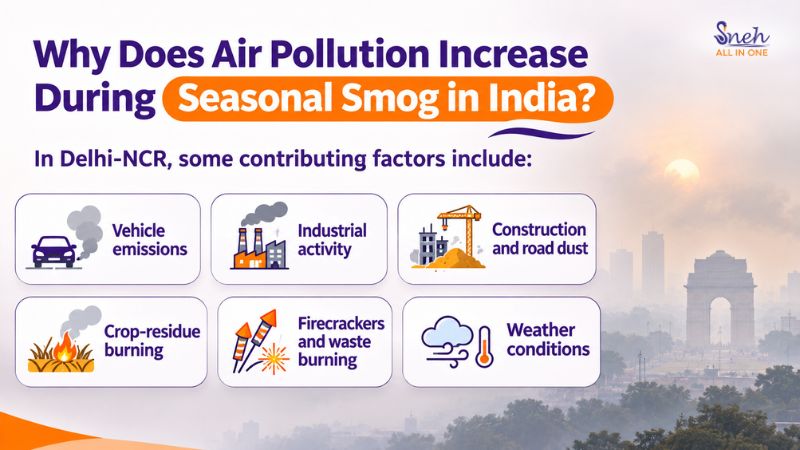
In Delhi-NCR, some contributing factors include:
The Ministry of Environment, Forest and Climate Change identifies transport, industrial activity, construction and road dust, biomass burning and waste burning among the sources contributing to air pollution in Delhi-NCR. It also explains that winter weather conditions can trap pollutants, while seasonal events such as stubble burning and firecrackers can add to the problem. Source: Press Information Bureau.
This combination can create visible smog and increase exposure to pollutants, particularly for people who spend long periods outdoors.
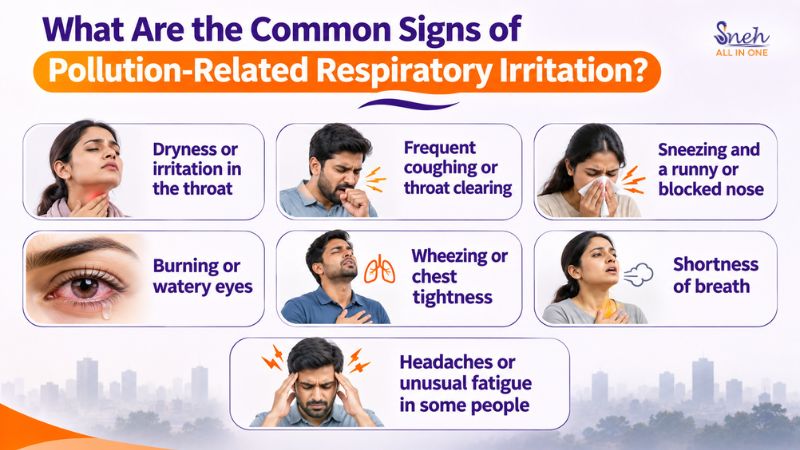
Exposure to polluted air can cause different symptoms depending on a person’s sensitivity and the level of pollution.
Common signs include:
People with asthma, chronic obstructive pulmonary disease (COPD), heart conditions or other respiratory problems may be more sensitive to poor air quality.
Seek medical advice if symptoms persist or become worse. Severe breathing difficulty, significant chest pain or sudden worsening of an existing respiratory condition requires urgent medical attention.
Some people may experience the effects of poor air quality more easily than others. They should take extra care during high-pollution periods.
The Ministry of Health and Family Welfare’s air pollution advisory identifies children, particularly those under five, pregnant women, older adults, people with pre-existing health conditions and outdoor workers as groups needing additional precautions. It recommends restricting outdoor movement as far as possible for vulnerable groups on poor-to-severe AQI days and avoiding strenuous activity when AQI levels are high.
You cannot control outdoor pollution on your own, but you can take practical steps to reduce your exposure.
Check the local AQI before outdoor exercise, morning walks or other activities. When pollution levels are high, avoid or move strenuous outdoor activity indoors.
People with asthma or other existing respiratory conditions should follow their doctor’s advice and keep prescribed medication accessible.
A properly fitted N95 or N99 mask can help filter airborne particles when outdoor exposure cannot be avoided. The mask should cover both the nose and mouth and fit closely around the face.
Cloth masks, scarves and handkerchiefs should not be treated as equivalent protection against fine particulate pollution. Follow the manufacturer’s instructions for use and replacement.
The MoHFW air pollution advisory recommends properly fitted N95 or N99 masks if you choose to wear one, and notes that they may help when exposure is short.
Indoor spaces can also contain dust, smoke and other pollutants. A few practical steps can help:
Avoid air-cleaning devices that intentionally generate ozone, as ozone can irritate the respiratory system.
People who travel through busy roads and traffic-heavy areas may experience repeated exposure to vehicle emissions.
You can reduce some exposure by choosing less congested routes where practical, avoiding unnecessary outdoor waiting near traffic and keeping vehicle windows closed during high-pollution periods. Use the vehicle’s air-conditioning recirculation setting when appropriate.
Drinking enough water throughout the day supports normal hydration and may help relieve the feeling of throat dryness. Warm water or other comfortable, non-irritating drinks may also feel soothing when your throat is dry.
However, hydration does not remove pollutants from the lungs or reverse the effects of prolonged exposure.
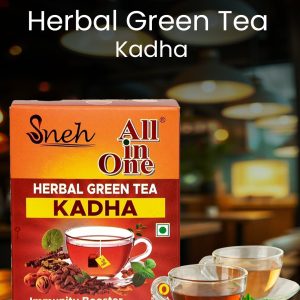
A warm drink can feel soothing on a dry throat, but it does not protect your lungs from pollution. SNEH Herbal Green Tea Kadha is a warm drink you can enjoy alongside the exposure-reduction steps above.
The warmth and fluid may provide temporary comfort when your throat feels dry or irritated. However, there is no established evidence that drinking Herbal Green Tea Kadha prevents air pollution from entering the lungs, removes inhaled pollutants or protects against pollution-related respiratory diseases.
If you enjoy a warm, spiced beverage during colder months, you can include it as part of your routine while continuing to follow practical steps to reduce pollution exposure.
SNEH Herbal Green Tea Kadha contains green tea, herbs and spices, along with stevia and rock salt. The complete ingredient declaration printed on the product pack lists the following ingredients in each 2.5 g tea bag:
Ingredient | Quantity per 2.5 g tea bag |
Haldi (Turmeric) | 0.187 g |
Ginger (Sonth) | 0.187 g |
Black Pepper | 0.187 g |
Pippali | 0.187 g |
Clove | 0.063 g |
Tulsi (Holy Basil) | 0.063 g |
Cardamom (Small) | 0.063 g |
Cardamom (Large) | 0.063 g |
Cinnamon | 0.063 g |
Nutmeg (Jaiphal) | 0.063 g |
Javitri (Mace) | 0.063 g |
Giloy (Amrita) | 0.063 g |
Mulethi (Liquorice) | 0.063 g |
Ashwagandha | 0.063 g |
Sendha Namak (Himalayan Rock Salt) | 0.063 g |
Stevia | 0.063 g |
Green Tea | 1.000 g |
The product pack states: “NO added sugar” and “NO artificial flavouring substances & preservatives.”
Follow the preparation instructions printed on the current product packaging. Use the water quantity, temperature and steeping time specified on the pack.
Herbal ingredients are not suitable for everyone, and natural products can still have side effects or interact with medicines.
For more information, refer to the NCCIH guidance on ashwagandha and NCCIH guidance on liquorice root.
Do not use Herbal Green Tea Kadha as a substitute for prescribed medication or medical care.
Check the AQI regularly, limit outdoor exertion when pollution is high, use a well-fitted N95 mask when necessary and improve indoor air quality. People with existing respiratory conditions should follow their doctor’s recommendations.
Drinking warm water or another comfortable warm beverage may temporarily soothe throat dryness. The MoHFW/NCDC air pollution advisory also recommends regular gargling with warm water and washing the eyes with running water. Avoid smoke and other irritants. If irritation continues, worsens or is accompanied by breathing difficulty, seek medical advice.
No. Herbal Green Tea Kadha is a warm beverage, not a pollution-protection measure. It cannot filter inhaled particles or prevent pollutants from entering the lungs.
SNEH hasn’t set a daily limit for this kadha. Because the blend contains liquorice, giloy and ashwagandha, don’t treat it as an unlimited daily drink. If you plan to have it every day, check with your doctor first, especially if you take medicines, are pregnant or breastfeeding, or have a liver, thyroid or blood-pressure condition.
Yes. SNEH Herbal Green Tea Kadha contains green tea, which naturally contains caffeine. SNEH doesn’t publish a per-cup caffeine figure. Write to care@snehallinone.com if you need more detail.
Do not assume that an adult herbal blend is suitable for children. Some ingredients may not be appropriate for them, and green tea contains caffeine. Consult a paediatrician before giving children Herbal Green Tea Kadha.
A well-fitted N95 or N99 mask can help reduce exposure to airborne particles, particularly during short periods of exposure. Fit is important, and masks should be used according to the manufacturer’s instructions. They do not eliminate exposure to every type of air pollutant.
It is better to avoid or move strenuous outdoor activity indoors when air quality is poor. Children, older adults and people with respiratory or heart conditions should take extra care and follow local health advisories.
Seek medical advice if coughing, wheezing, chest tightness or breathing discomfort persists or worsens. Severe breathlessness, significant chest pain or a sudden serious worsening of symptoms requires urgent medical attention.
Smog season can make everyday activities less comfortable, especially when outdoor air quality is poor. Checking the AQI, reducing outdoor exposure, wearing a well-fitted N95 mask when needed and keeping indoor air clean are practical steps that can help you make informed choices.
And when you want something warm after a long day, a cup of SNEH Herbal Green Tea Kadha offers a familiar blend of green tea, herbs and spices. Enjoy it as a comforting beverage alongside sensible pollution precautions—not as a substitute for them.
You can browse the SNEH All In One shop to see the available products.
For more seasonal wellness information, read How Weather Changes Affect Immunity. You can also learn more about the brand on the SNEH All In One About Us page.
This article is for general informational purposes only and is not a substitute for professional medical advice, diagnosis or treatment. Herbal beverages are not proven to prevent or treat pollution-related respiratory conditions. Consult a qualified healthcare professional before using herbal products, especially if you have an existing medical condition, take medication, are pregnant or are considering them for a child.

Written by: SNEH All In One Editorial Team Yes, you can drink plain, unsweetened herbal tea during intermittent fasting. A simple brewed herbal tea contains

Written by: Sneh All In One Editorial Team Herbal Green Tea Kadha is a ready-to-brew tea bag blend made with green tea extract and traditional

Sitting at a desk for long hours can contribute to digestive discomfort, including bloating, gas, constipation and acidity. Irregular meals, rushed eating, low fluid intake