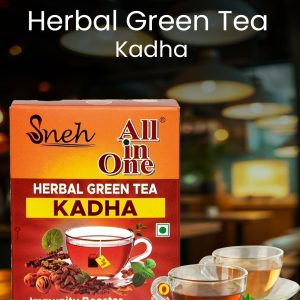
How to Choose the Right Herbal Kadha Tea
Author: SNEH All In One Team A good herbal kadha tea has clearly listed ingredients, suitable caffeine levels, simple brewing instructions and reliable packaging and

Author: Anu Sharma – Herbal Tea Specialist with 21+ Years of Experience
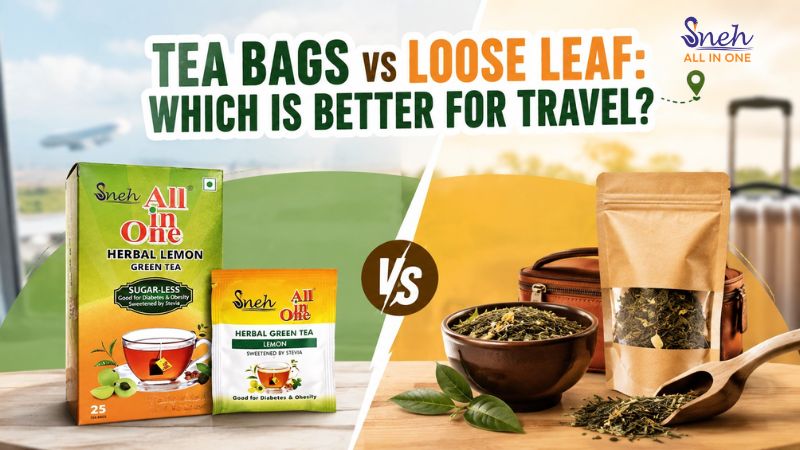
If you are choosing between tea bags and loose leaf for travel, tea bags are usually the better option because they are compact, pre-portioned, easy to brew, and require minimal equipment.
Loose leaf tea is worth considering when flavor control, multiple infusions, and the brewing experience matter more than convenience.
Your ideal choice ultimately depends on the length of your trip, available brewing equipment, packing space, and how you prefer to drink tea.
Travel Factor | Tea Bags | Loose Leaf Tea |
Portability | Excellent | Good |
Preparation | Very easy | Requires extra equipment |
Mess-free use | Excellent | Moderate |
Portion control | Easy | Requires measuring |
Flavor control | Moderate | Excellent |
Re-steeping value | Usually limited | Often better |
Cost per cup | Fixed per serving | Lower per cup with re-steeping |
Sustainability | Depends on bag and packaging | Often less packaging |
Hotel-room convenience | Excellent | Moderate |
Best for light packing | Yes | Not usually |
Quick takeaway: Choose tea bags when convenience and simple packing are your priorities. Choose loose leaf when brewing quality and re-steeping matter more.
Tea bags contain a measured quantity of tea or herbal ingredients inside a filter material. You simply place the bag in hot water and remove it after steeping.
Loose leaf tea contains leaves or dried ingredients without an individual filter. Brewing usually requires an infuser, strainer, or another suitable method.
The format alone does not determine quality. The type of ingredients, freshness, processing, leaf size, and packaging all influence the final cup.
Tea grade helps explain why loose leaf tea is often associated with stronger flavor and better brewing control.
However, loose leaf tea is not automatically better than tea bags. A high-quality tea bag can contain good ingredients, while low-quality loose leaf may provide a disappointing cup.
For traveling, consider both quality and practicality rather than judging the tea solely by its format.
Tea bags have a clear advantage for travelers because they combine portability, simple preparation, portion control, and low cleanup.
Their compact format makes tea bags easy to carry without adding significant weight or bulk.
You can pack several individual servings in a small pouch or suitcase compartment. Individually wrapped bags are particularly useful because they remain protected from moisture and odors.
This makes them practical for flights, weekend trips, business travel, and journeys where luggage space is limited.
A cup and hot water are generally enough to prepare a tea bag.
You do not need to carry a separate infuser, strainer, measuring spoon, or teapot. Many hotel rooms also provide a kettle or hot-water facility, making preparation straightforward.
This is especially useful when you are traveling between hotels or staying somewhere with limited kitchen facilities.
Each tea bag provides a ready-to-use serving, so there is no need to measure leaves while traveling.
This makes preparation more consistent and reduces the chance of carrying more tea than you actually need.
Individually packed servings can also be shared easily without opening a larger container.
The enclosed format keeps the tea contained before, during, and after brewing.
With loose leaf tea, you may need to remove wet leaves from an infuser and clean the brewing equipment afterward. Tea bags eliminate most of that cleanup.
For travelers who frequently change locations, this small difference can make preparation much easier.
Tea bags are particularly practical when you only need a few servings during a short journey.
Instead of carrying a container of loose leaves and a brewing device, you can pack the exact number of servings required.
For a two- or three-day trip, this keeps your tea routine simple without adding unnecessary items to your luggage.
Loose leaf tea can be the better travel choice when flavor control and multiple infusions are more important than convenience.
Loose leaf allows you to adjust the amount of tea, water, and steeping time to suit your preference.
You can make a lighter or stronger cup without being limited to the quantity contained in one tea bag.
The larger leaf structure of some loose teas can also provide a different brewing experience compared with fine particles designed for rapid extraction.
If you enjoy preparing tea as part of the travel experience, carrying a compact infuser may be worthwhile.
Some whole-leaf teas can be steeped several times, making a small quantity useful for multiple cups.
The number of successful infusions depends on the tea variety, leaf quality, water temperature, and steeping method.
This can make loose leaf more economical on longer trips because the same leaves may provide several servings.
When buying tea for travel, focus on freshness, ingredients, packaging, and the material used for the tea bag rather than assuming one format is always superior.
For tea bags, check whether the individual bags are properly sealed and whether the packaging protects them from moisture and odors.
For loose leaf tea, look for fresh-smelling leaves and packaging that provides good protection from air, moisture, light, and strong odors.
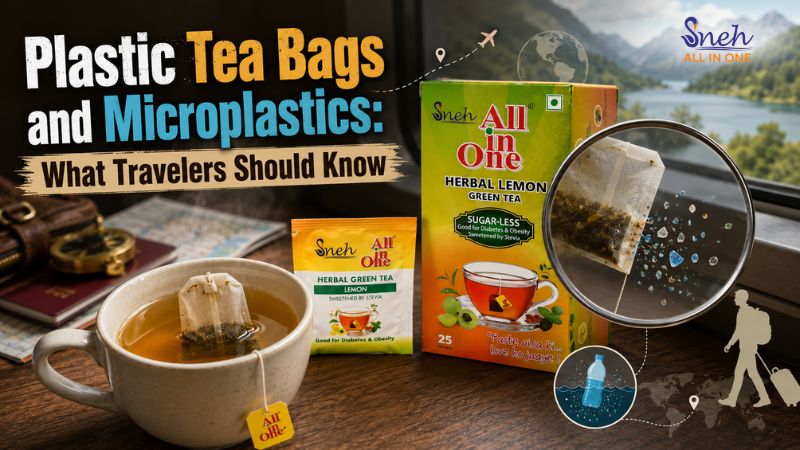
If avoiding plastic is important to you, check the tea bag material before purchasing. Do not assume that a pyramid or mesh-style bag is automatically plastic-free.
Not all tea bags use the same materials. Some pyramid-style or mesh bags may contain synthetic materials such as nylon or PET.
Research has investigated whether certain plastic tea bags can release micro- and nanoscale particles during brewing. One widely cited study reported substantial particle release from the specific plastic bags it tested, while later research questioned aspects of its methodology.
The practical takeaway is to check the material of your tea bags if you want to reduce exposure to plastic-based packaging.
Paper-based, plastic-free, or appropriately certified compostable options may be preferable when available. However, packaging claims should be checked carefully because “biodegradable,” “compostable,” and “plastic-free” do not necessarily mean the same thing.
Loose leaf can reduce packaging waste because you do not need a separate filter bag for every serving.
Tea bags can generate more packaging waste when each serving is individually wrapped and contains synthetic materials.
However, the sustainability difference depends on the specific product. A tea bag made from suitable compostable or paper-based material with minimal packaging may have a lower packaging footprint than heavily packaged loose leaf tea.
For travelers, consider the entire package rather than the tea format alone: how much packaging is used, whether the bag contains plastic, and how much tea you actually need for the trip.
Keep tea bags dry, sealed, and protected from strong odors.
Whenever possible, leave individually wrapped tea bags in their original packaging. If they are not individually sealed, place them inside a clean airtight pouch or small container.
Avoid storing them next to:
Use a small airtight container or resealable pouch to protect loose leaf tea during travel.
Pack only the amount you expect to use. A compact travel infuser can then provide the equipment needed for brewing.
Keep loose leaves away from moisture and strong odors because dried tea can absorb surrounding smells.
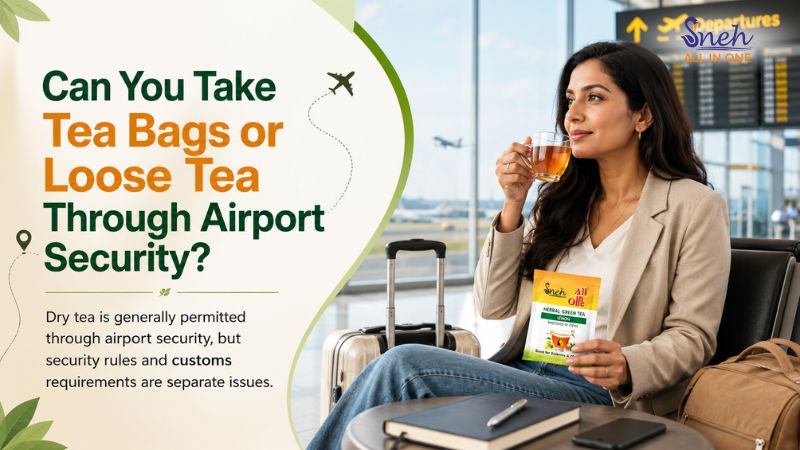
Dry tea is generally permitted through airport security, but security rules and customs requirements are separate issues.
The U.S. Transportation Security Administration (TSA) lists dry tea bags and loose tea leaves as permitted in both carry-on and checked baggage. Security officers can still inspect food items during screening.
Dry tea is not subject to the standard liquid restriction because it is a solid. However, very finely powdered tea may receive additional screening under rules applicable to powders, so powdered tea should not automatically be treated the same way as loose leaves.
There is also no universal TSA 12 oz (340 g) limit specifically for dry tea. Some travel sources mention that quantity as informal guidance for certain powders, but it should not be treated as an official blanket tea limit.
For international travel, check your airline and destination country’s current requirements before departure.
Getting tea through airport security does not automatically mean you can take it into another country.
Customs and agricultural authorities may have separate rules covering food, plants, seeds, herbs, and other biological materials.
This matters particularly for loose herbal blends containing dried flowers, roots, leaves, or other botanical ingredients.
Keeping tea in its original labeled packaging can make identification easier if customs or security officials inspect it.
The best tea for travel depends on what matters most during your journey.
For a short business trip or flight, tea bags are usually the simplest option.
For a longer leisure trip where you already carry a compact infuser, loose leaf may provide better brewing flexibility.
Yes, some loose leaf teas can be steeped multiple times. Whole-leaf varieties are often better suited to re-steeping, although results depend on the tea, water temperature, and brewing time.
Tea generally stays in good condition when stored in an airtight, dry, and odor-free environment. Avoid excessive heat, moisture, direct sunlight, and repeated exposure to air.
The liquid restriction applies to the beverage, not dry tea leaves or tea bags. A filled travel mug contains liquid and may therefore be subject to airport security rules governing liquids. Emptying the container before security and filling it afterward is generally the simpler approach, subject to the airport’s current rules.
Whether you can carry an electric kettle depends on airline and destination rules, as well as the kettle’s size and design. If you need one for a trip, check your airline’s baggage policy before packing it rather than assuming it is permitted in a particular bag.
Tea bags are generally the better choice for travel because they are compact, pre-portioned, easy to prepare, and require very little equipment.
Loose leaf tea makes more sense when you want greater control over brewing, multiple infusions, and a more traditional tea experience.
The simplest rule is:
Choose tea bags for convenience. Choose loose leaf for brewing control and re-steeping value.
Whichever format you choose, protect the tea from moisture, heat, light, and strong odors. For international journeys, also check the latest customs requirements for your destination before packing botanical or herbal products.
Anu Sharma – Herbal Tea Specialist with 21+ Years of Experience
Anu Sharma writes about herbal tea, tea preparation, ingredient quality, and practical everyday tea habits, with a focus on clear, responsible, experience-based guidance for consumers.

Author: SNEH All In One Team A good herbal kadha tea has clearly listed ingredients, suitable caffeine levels, simple brewing instructions and reliable packaging and
Author: SNEH All In One Editorial TeamReviewed by: SNEH All In One Herbal Tea Specialists Our SNEH All In One green-tea-based Herbal Masala Tea is
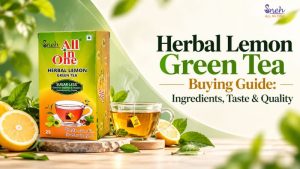
Written by: Anu Sharma – Herbal Tea Specialist with 21+ Years of ExperienceBrand: SNEH All In One – Naturally Crafted Teas Brand Disclosure: This guide