What Makes a Good Herbal Tea Blend? A Guide to Ingredients and Quality
A good herbal tea blend combines quality botanicals, balanced proportions, freshness, a clean aroma, suitable packaging and transparent labelling. The number of herbs in the

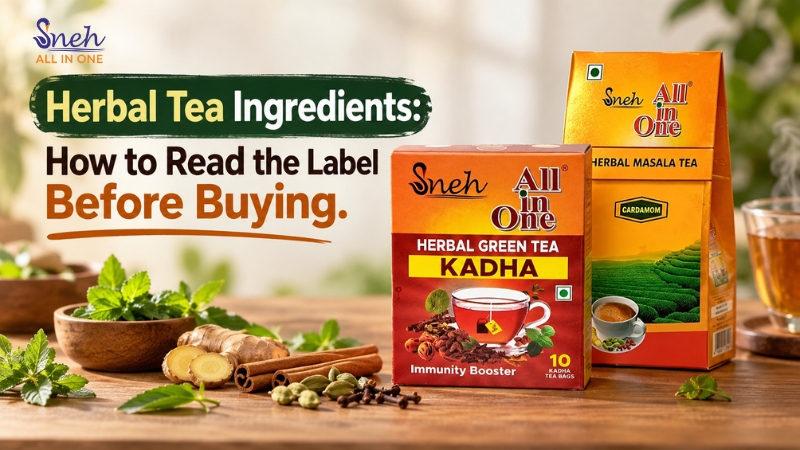
To understand herbal tea ingredients before buying, read the ingredient list instead of relying only on the product name or front-of-pack claims. Check the order of ingredients, identify the herbs used, look for added sweeteners or flavouring substances, check certifications and FSSAI details, and review serving, storage and safety information. This helps you understand what is actually in the blend and choose a product that suits your preferences.
A herbal tea ingredients list is the part of the package that tells you which herbs, spices, flowers, roots, fruits, flavouring substances, sweeteners and other ingredients are used.
Reading this list helps you understand the actual formulation instead of judging a product only by its name, packaging or marketing claims.
Green, black, white and oolong teas are made from Camellia sinensis. Many products sold as herbal teas are instead infusions or tisanes made from herbs, flowers, spices, roots or fruits.
If caffeine matters to you, check the ingredients rather than assuming that every product labelled “tea” is caffeine-free.
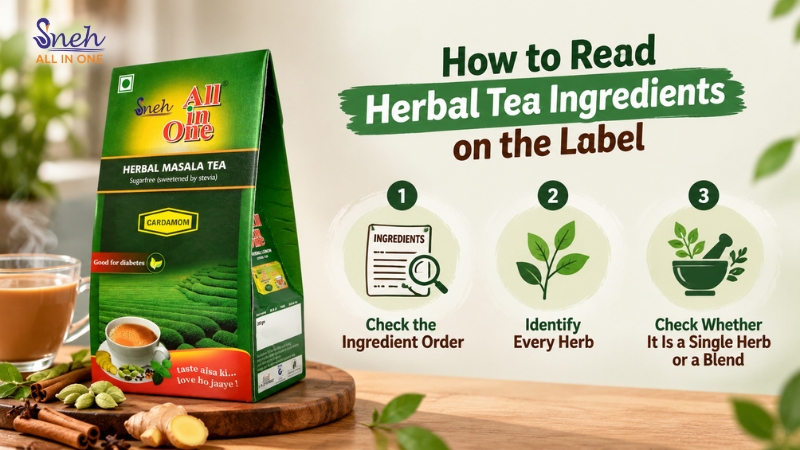
Food labels generally list ingredients in descending order of proportion, as set out in FSSAI’s labelling regulations.
This means the first ingredient is generally present in the highest proportion, while ingredients appearing later are present in smaller amounts.
The order can help you understand whether a product is mainly one herb or a broader blend.
Read the complete herbal tea ingredients list and check the name of every herb, spice, flower, root or fruit used.
Do not rely only on the main name on the front of the package. A product called “lemon tea,” for example, may contain lemon flavouring rather than actual lemon pieces.
Understanding each ingredient also helps you identify anything you may need to avoid because of an allergy, sensitivity, dietary preference or personal choice.
A single-herb tea contains one primary botanical ingredient, while a blend combines several herbs, spices, flowers or other ingredients.
More ingredients do not automatically mean a better product. What matters is whether the formulation is clear, relevant to your preferences and made with ingredients you are comfortable consuming.
Herbal tea ingredient | Commonly associated use | What to check |
Chamomile | Often used in calming or evening tea blends | Check for allergies and personal sensitivities |
Ginger | Commonly used in digestive and warming blends | Check the overall blend and serving guidance |
Peppermint | Often used for a refreshing flavour and after-meal teas | Consider personal tolerance |
Fennel | Commonly included in digestive tea blends | Check the complete formulation |
Licorice root | Used for its naturally sweet taste in some blends | Check suitability if you have health conditions or take medicines |
Hibiscus | Commonly used for its tart flavour and colour | Check the blend and serving guidance |
These common associations do not guarantee a specific health effect. The purpose of checking the ingredient list is to understand what the product contains and whether it suits your needs.
“Natural flavour” does not simply mean whole food or whole herb. In India, FSSAI’s food-additive framework recognises three broad categories of flavouring substances: natural, nature-identical and artificial under the Food Safety and Standards (Food Products Standards and Food Additives) Regulations, 2011.
Therefore, “natural lemon flavour” does not necessarily mean that the product contains dried lemon pieces or fresh lemon.
Natural also does not automatically mean safer or suitable for everyone. If you have allergies or specific dietary or health considerations, read the complete ingredient list carefully.
Look for ingredients such as sugar, jaggery, stevia or other sweeteners if you are monitoring your intake.
Also check whether the product contains natural, nature-identical or artificial flavouring substances. This helps you understand whether the flavour comes mainly from the listed herbs and spices or from added flavouring.
Your personal avoid list may include specific herbs, sweeteners, flavouring substances or other ingredients.
If you have an allergy, sensitivity, dietary restriction or take medicines, review the full formulation before choosing a blend. Some herbs can interact with medicines, so additional caution may be appropriate.
Do not assume that every herbal tea product may be caffeine-free. Some products marketed as herbal or tea blends may contain ingredients that naturally provide caffeine.
If you want to avoid caffeine, check the ingredient list and product information before buying.
A good label should make it easy to understand what the product contains. Avoid relying only on broad claims such as “natural,” “wellness” or “herbal.”
A clear ingredient list, manufacturer information, serving guidance and storage instructions give you more useful information when comparing products.
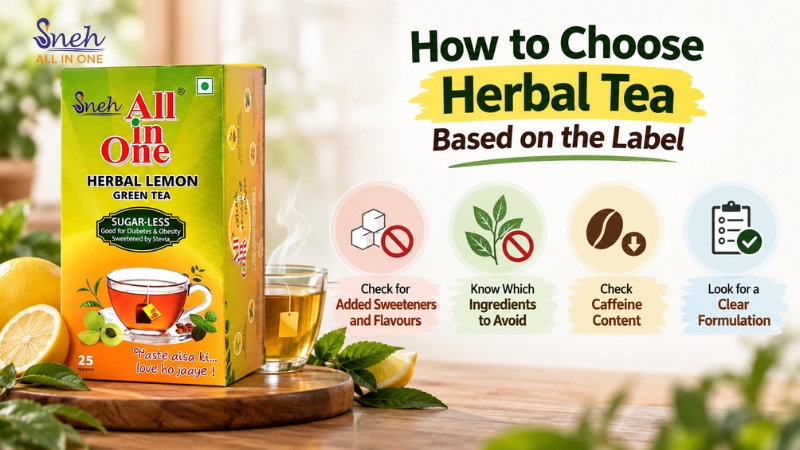
When buying herbal tea in India, check the label for important product information, including:
An FSSAI licence is a regulatory requirement for applicable food businesses; it should not be treated as an independent endorsement of a product’s quality.
The herbal tea ingredients list tells you what is used, but the serving information tells you how the product is intended to be prepared or consumed.
Check the recommended serving size, preparation instructions, net quantity and storage directions before buying.
This is especially useful when comparing products sold in different pack sizes or in loose-leaf, powder or tea-bag formats.
Before buying, quickly check:
Reviewed by Anu Sharma – Herbal Tea Specialist with 21+ Years of Experience
At SNEH All In One – Naturally Crafted Teas, we believe consumers should understand what they are choosing. Reading the label is one of the simplest ways to understand the formulation of a herbal tea before buying it. Instead of choosing only by flavour name or health-related claims, compare the actual ingredients, their order and the product information provided on the package.
Start with the complete ingredient list and check the order, individual herbs, sweeteners, flavouring substances and any ingredients you need to avoid. Then review FSSAI details, batch information, serving instructions and other product information.
Look for a clear ingredient list, understandable formulation, relevant product information and ingredients that suit your preferences. Also check for added sweeteners, flavouring substances, caffeine and ingredients you may need to avoid.
No, a longer ingredient list does not automatically mean a better herbal tea. Focus on the purpose of the blend, ingredient clarity and whether the formulation suits your preferences.
Natural flavour refers to flavouring substances derived from natural sources through permitted processes. It does not necessarily mean that the product contains the whole fruit, herb or spice named in the flavour.
No, they are not always the same. Real tea comes from Camellia sinensis, while many herbal teas are infusions made from herbs, flowers, spices, roots or fruits.
The ingredients you should avoid depend on your individual allergies, sensitivities, dietary requirements and health circumstances. Always read the complete ingredient list and seek appropriate professional advice if you are unsure about an ingredient.
Some herbal tea products may contain caffeine, depending on their ingredients. If you want a caffeine-free option, check the ingredient list and product information instead of relying only on the product name.
Daily use depends on the specific ingredients, amount consumed and your individual circumstances. If you take medicines, have a health condition, are pregnant or breastfeeding, or have concerns about a particular herb, check with a qualified healthcare professional before regular use.
Reading herbal tea ingredients before buying helps you make a more informed choice. Check the ingredient order, understand each component, identify added sweeteners or flavouring substances, review FSSAI and batch information, and consider your own dietary and safety needs.
A clear label gives you a better understanding of what is actually inside the product and makes it easier to compare different herbal tea blends.

A good herbal tea blend combines quality botanicals, balanced proportions, freshness, a clean aroma, suitable packaging and transparent labelling. The number of herbs in the
To understand herbal tea ingredients before buying, read the ingredient list instead of relying only on the product name or front-of-pack claims. Check the order
Yes, you can reuse tea bags, and for most everyday teas, two cups from one tea bag is a practical limit. The second cup will