Can Herbal Lemon Tea Help With Hormonal Balance? What Women Should Know
Written by: Sneh All In One Editorial Team Herbal lemon tea does not balance or treat hormones. It can fit into a healthy routine as


Written by: Sneh All In One Editorial Team
Herbal lemon tea does not balance or treat hormones. It can fit into a healthy routine as a flavourful drink, but Sneh All In One Herbal Lemon Tea contains 4.60 g of sugar per serving, so it is not sugar-free. For persistent period changes, severe pain, or PCOS symptoms, see a doctor.
Herbal lemon tea may fit into a healthy lifestyle, but there is no good evidence that drinking it directly balances reproductive hormones. Its role is better understood as a flavourful beverage that can support everyday habits such as hydration and replacing other drinks.
The individual ingredients may have their own properties, but research on one ingredient does not prove that the complete tea blend has the same effect.
It can replace some sweetened drinks. Choosing tea instead of a more heavily sweetened drink can be one simple way to manage overall beverage choices. This tea itself contains 4.60 g of sugar per serving, so its nutrition should still be considered.
It can support regular hydration. Drinking fluids regularly is an important part of everyday health. Tea can be one option alongside water and other suitable beverages.
It can become part of a calming routine. A warm, lemon-flavoured drink can be an enjoyable part of a regular routine. This should not be confused with a direct effect on hormone levels.
It can complement a hormone-friendly lifestyle. A healthy diet and an active lifestyle are important parts of PCOS management. The Endocrine Society notes that a healthy diet and regular exercise can help women with PCOS. Endocrine Society: PCOS
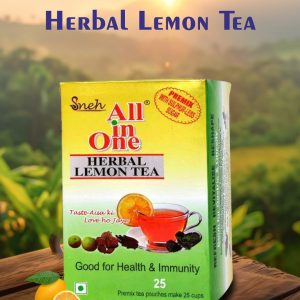
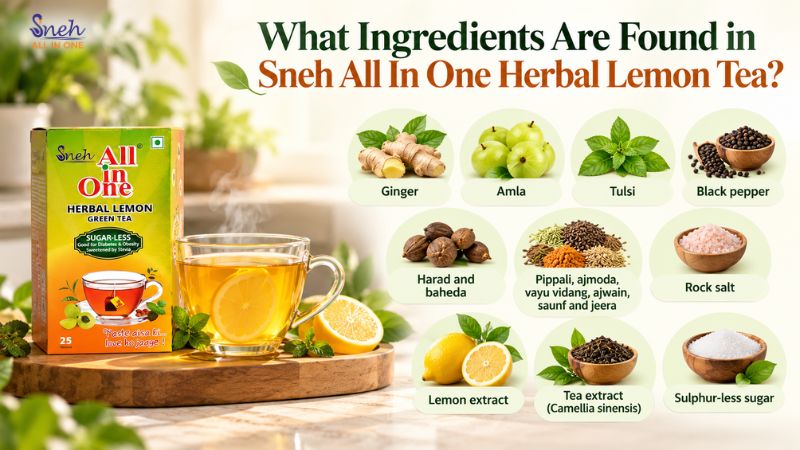
Sneh All In One Herbal Lemon Tea is a multi-herb blend that includes ginger, tulsi, amla and black pepper, along with other herbs, spices, lemon extract and tea extract. Of these ingredients, ginger dietary supplements have been studied for menstrual cramps; this does not establish that the complete blend balances hormones. NCCIH: Ginger
Ingredient | What it contributes to the blend |
Ginger | Traditionally used as a warming spice; ginger dietary supplements have been studied for menstrual cramps. |
Amla | A fruit commonly used in traditional preparations and a source of vitamin C. Vitamin C functions as an antioxidant and supports collagen formation and iron absorption. NIH ODS: Vitamin C |
Tulsi | A traditional herb used in herbal beverages. |
Black pepper | A spice included in the blend for flavour. |
Harad and baheda | Traditional herbal ingredients included in the formulation. |
Pippali, ajmoda, vayu vidang, ajwain, saunf and jeera | Herbs and spices included in the blend. |
Rock salt | Included as part of the formulation. |
Lemon extract | Provides lemon flavour to the blend. |
Tea extract (Camellia sinensis) | Tea extract listed in the formulation. |
Sulphur-less sugar | Used to sweeten the product. |
Each 10 g serving provides 29.08 kcal and 4.60 g of sulphur-less sugar according to the product information. Here, sulphur-less sugar refers to refined sugar processed without sulphur.
The amount of a nutrient or compound present in an individual ingredient does not automatically mean that the brewed tea provides a clinically meaningful dose.
The product is marketed as a caffeine-free herbal tea, but its listed formulation also includes tea extract (Camellia sinensis), a plant that naturally contains caffeine.
Because a tested caffeine amount has not been provided here, anyone who needs to avoid caffeine strictly should check the current product label or confirm the tested caffeine content with the manufacturer before regular use.
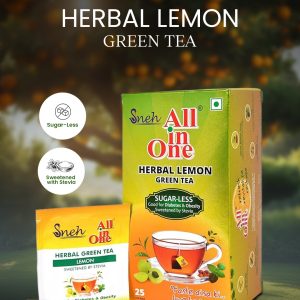
Note: The product is listed under a green-tea category, while its formulation and product description present it as an herbal blend. The ingredient list is the more useful reference when checking what the product contains.
Not necessarily. Herbal products are not automatically suitable for everyone.
If you are pregnant, breastfeeding, taking medicines, or managing a health condition, check the ingredients and discuss regular use with your healthcare professional. Ginger can cause abdominal discomfort, heartburn, diarrhoea, and mouth or throat irritation, and herbs can interact with medicines.
You should also be cautious if you have known allergies, frequent acid reflux, digestive sensitivity, or dietary restrictions.
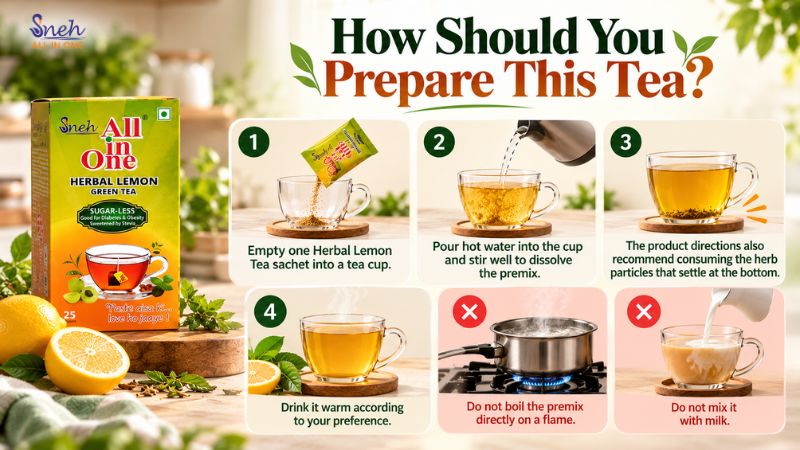
Use one Sneh All In One Herbal Lemon Tea sachet in a cup, add hot water, and stir well until the premix dissolves. The product directions do not specify an exact water quantity or steeping time.
There is no proven hormone-specific serving schedule for Herbal Lemon Tea. Follow the product directions and use it according to your personal preference.
Important: The product information lists the tea as caffeine-free, while the ingredient list also includes tea extract (Camellia sinensis). If you need to strictly avoid caffeine, check the current product label or tested caffeine content before use.
Herbal lemon tea can be enjoyed as a beverage during different stages of life, but its role and safety can vary depending on your health needs, medications and the ingredients in the blend.
Ginger dietary supplements have been studied for menstrual cramps, and research suggests they might reduce the severity of menstrual pain. However, this evidence does not prove that a complete herbal lemon tea blend will have the same effect.
If period pain is severe, worsening, or interferes with everyday activities, it is important to speak with a healthcare professional. ACOG notes that conditions such as endometriosis, ovarian cysts, adenomyosis and fibroids can cause painful periods. ACOG: Painful Periods
Herbal lemon tea does not treat PCOS. PCOS is associated with metabolic concerns including insulin resistance, which is a risk factor for type 2 diabetes. Endocrine Society: PCOS
A healthy diet and regular physical activity are important parts of PCOS management. Endocrine Society: PCOS and lifestyle
For this product, each 10 g serving contains 4.60 g of sugar, so this tea is not a sugar-free option.
Perimenopause is the transition leading up to menopause and can involve changes in menstrual cycles, hot flashes, sleep, mood and other symptoms. National Institute on Aging: What Is Menopause?
This tea can be included as a beverage if it suits you, but it is not a treatment for perimenopausal hormone changes. If symptoms are troublesome or disruptive, talk with a doctor about suitable options.
Pregnancy and breastfeeding require extra care with herbal products because safety can depend on the individual ingredients and amounts consumed.
Do not assume that a product is suitable simply because it is labelled herbal. Check the current ingredient list and ask your healthcare professional before making it a regular part of your routine.
The main differences between these teas are their ingredients, caffeine content, preparation and the evidence available for specific uses.
Tea | Main consideration |
Herbal lemon tea | Flavourful herbal blend; this product contains 4.60 g sugar per 10 g serving and lists tea extract. |
Green tea | Made from Camellia sinensis and naturally contains caffeine. |
Ginger tea | Ginger dietary supplements have been studied for menstrual cramps, although this does not prove the same effect from every tea. |
Tulsi tea | Usually caffeine-free when made only from tulsi. |
Spearmint tea | Small studies have investigated spearmint in relation to androgen-related symptoms, but evidence remains limited. |
No single tea can be considered the best tea for hormonal balance based on current evidence.
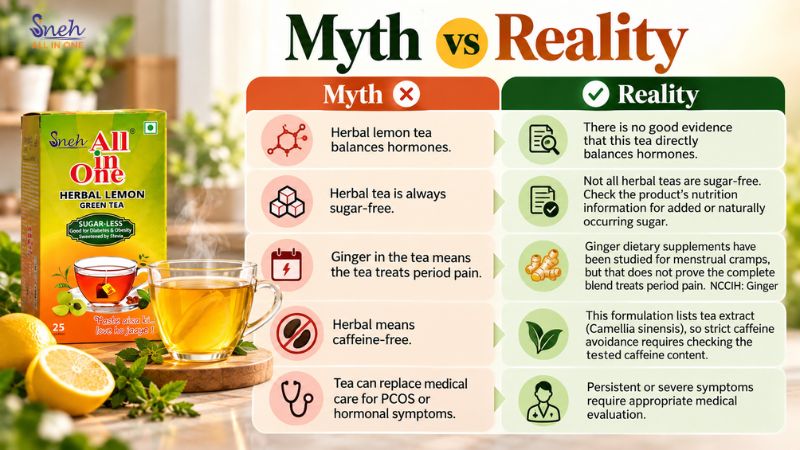
Myth | Reality |
Herbal lemon tea balances hormones. | There is no good evidence that this tea directly balances hormones. |
Herbal tea is always sugar-free. | Not all herbal teas are sugar-free. Check the product’s nutrition information for added or naturally occurring sugar. |
Ginger in the tea means the tea treats period pain. | Ginger dietary supplements have been studied for menstrual cramps, but that does not prove the complete blend treats period pain. NCCIH: Ginger |
Herbal means caffeine-free. | This formulation lists tea extract (Camellia sinensis), so strict caffeine avoidance requires checking the tested caffeine content. |
Tea can replace medical care for PCOS or hormonal symptoms. | Persistent or severe symptoms require appropriate medical evaluation. |
See a healthcare professional if symptoms are persistent, severe, new, or affecting your daily life.
You should seek medical advice for concerns such as:
ACOG advises evaluation when a previously established period stops for more than 3 months. ACOG: Amenorrhea
Severe or worsening period pain can also require evaluation because conditions such as endometriosis, fibroids, adenomyosis and ovarian cysts may be involved.
It can be enjoyed as a beverage during your period, but it should not be considered a treatment for menstrual problems. Ginger dietary supplements have been studied for menstrual cramps, although this does not establish the same effect for the complete tea blend.
There is not enough evidence to say that drinking tulsi tea directly balances hormones. Tulsi can be part of a herbal beverage, but hormonal conditions require appropriate medical evaluation when symptoms persist.
Herbal lemon tea does not treat PCOS. Lifestyle measures such as a healthy diet and regular physical activity are important parts of PCOS management. Endocrine Society: PCOS and lifestyle
For the sugar content of this product, see the nutrition details above.
There is no single tea proven to balance hormones. The right choice depends on the ingredients, your health needs, caffeine tolerance, sugar intake and any medicines you take.
There is no established hormone-specific daily dose for herbal lemon tea. If you want to drink it regularly, consider the full ingredient list, its nutrition information and whether it is appropriate for your individual health needs.
Herbal lemon tea can be part of a balanced routine, but it should not be relied on to balance hormones. Sneh All In One Herbal Lemon Tea can be considered as a flavourful beverage alongside a healthy diet and lifestyle.
For persistent hormonal symptoms, irregular periods, severe pain or PCOS concerns, talk to your doctor rather than relying on tea alone.
Want to try Sneh All In One Herbal Lemon Tea? View Sneh All In One Herbal Lemon Tea
Lorem ipsum dolor sit amet, consectetur adipiscing elit. Ut elit tellus, luctus nec ullamcorper mattis, pulvinar dapibus leo.

Written by: Sneh All In One Editorial Team Herbal lemon tea does not balance or treat hormones. It can fit into a healthy routine as
Author: SNEH All In One Team A good herbal kadha tea has clearly listed ingredients, suitable caffeine levels, simple brewing instructions and reliable packaging and
Author: SNEH All In One Editorial TeamReviewed by: SNEH All In One Herbal Tea Specialists Our SNEH All In One green-tea-based Herbal Masala Tea is