How to Choose the Right Herbal Kadha Tea
Author: SNEH All In One Team A good herbal kadha tea has clearly listed ingredients, suitable caffeine levels, simple brewing instructions and reliable packaging and

Author: Anu Sharma – Herbal Tea Specialist
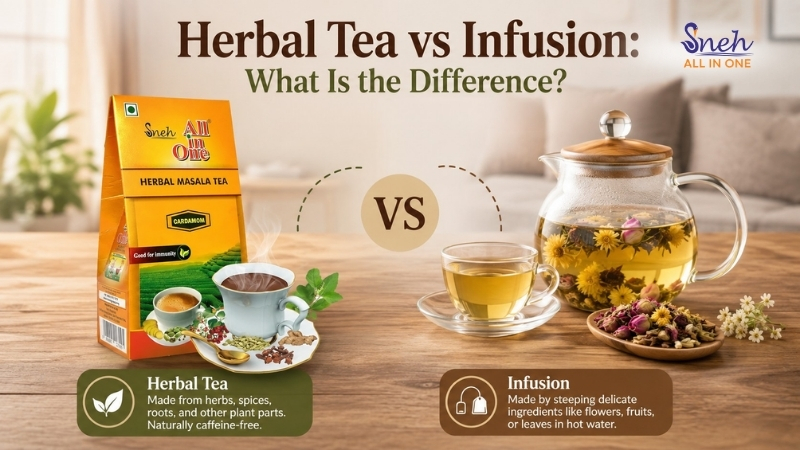
A herbal tea is usually a ready-to-drink beverage made by steeping herbs in water, while an infusion is the preparation method used to extract compounds from plant material. A traditional infusion often uses more herbs and a longer steep than an everyday cup.
The terms can overlap, though. A cup of chamomile made by steeping flowers in hot water can be both an herbal tea and a chamomile infusion.
The important distinction is therefore how the terms are being used. “Herbal tea” generally describes the beverage, while “infusion” focuses more on the extraction process.
The easiest way to understand the difference between tea and infusion is to compare their purpose, preparation, and typical use.
Feature | Herbal Tea | Herbal Infusion |
Basic meaning | Usually the finished herbal beverage | A method of extracting plant material in water |
Main purpose | Convenient drinking and enjoyment | More controlled herbal preparation |
Herb quantity | Often a smaller amount | May use a larger amount |
Steeping | Usually shorter | Often longer |
Preparation | Commonly one cup | One cup or a larger batch |
Ingredients | Herbs, flowers, spices, fruits, and blends | Often leaves and flowers suitable for steeping |
Strength | Usually prepared for balanced flavor | Can be stronger depending on ratio and steeping time |
Bottom line: Herbal tea is generally the beverage, while an infusion is primarily the preparation method. In everyday use, the two terms can describe the same drink.
A herbal infusion is a water-based preparation made by steeping plant material in water to extract its soluble compounds, flavor, and aroma.
The herbal infusion meaning is therefore more closely connected with the extraction process than with a particular finished drink.
Leaves and flowers are commonly suited to this method because their components can be extracted without prolonged boiling.
Common examples include:
A basic infusion involves placing the herb in a container, adding water, covering it, allowing it to steep, and then straining the plant material.
The exact amount of herb and steeping time depends on the ingredient and intended preparation.
No. Calling something an infusion does not automatically make it stronger.
The final strength depends on:
A longer steep may create a stronger preparation, but it can also produce a more bitter or intense flavor.
Herbal tea is the common name for a beverage prepared by steeping herbs, flowers, spices, fruits, roots, or other botanical ingredients in water.
Most herbal teas are not made from Camellia sinensis, the plant used to produce traditional black, green, white, and oolong teas.
Instead, an herbal blend may contain ingredients such as:
The word “tea” is commonly used because the beverage is prepared and enjoyed in a similar way to traditional tea.
This means herbal tea generally describes what you drink, whereas infusion describes more specifically how plant material is extracted in water.
For a broader explanation of herbal tea types and terminology, see our guide to What Is Herbal Tea? Types, Benefits & How It Works.
The herbal infusion vs tea distinction becomes easier when you separate the beverage from its preparation method.
Herbal tea generally describes the finished beverage, while infusion describes the process of steeping plant material in water.
For example, dried chamomile flowers steeped in hot water create an infusion. The resulting drink can also be called chamomile herbal tea.
This is why the two terms are often used interchangeably in everyday conversation.
A common starting point is about 1–3 tablespoons of dried herbs per cup of water, but the appropriate amount varies by herb and preparation method.
Some traditional larger-batch preparations use different measurements, such as approximately 1 ounce of dried herb by weight per quart of water. These figures are general preparation references rather than universal rules.
Different herbs have different densities, strengths, and recommended preparation methods. A tablespoon of one dried herb can weigh very differently from a tablespoon of another.
For that reason, follow the preparation instructions supplied with a specific herb or blend whenever available.
The ratio affects:
Using more plant material does not automatically make a preparation better. A balanced ratio is often more appropriate for an enjoyable everyday beverage.
Yes. Steeping time affects the strength, flavor, and extraction of an herbal preparation, but longer is not always better.
A regular cup may be steeped for several minutes, while a traditional infusion may be allowed to steep for considerably longer. Some traditional preparation methods use several hours or even overnight, depending on the herb and intended preparation.
Preparation style | General approach |
Everyday herbal beverage | Shorter steep for balanced taste |
Traditional infusion | Longer steep for more extensive extraction |
Cold infusion | Longer contact time at a lower temperature |
Decoction | Simmering tougher plant parts |
There is no single steeping time that works for every herb.
For packaged products, always follow the manufacturer’s recommended brewing instructions.
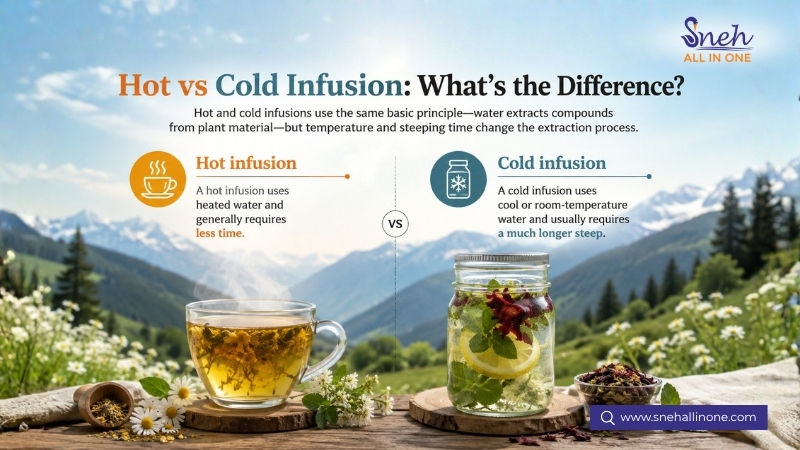
Hot and cold infusions use the same basic principle water extracts compounds from plant material but temperature and steeping time change the extraction process.
A hot infusion uses heated water and generally requires less time.
It is commonly used for delicate herbs such as:
Hot water can extract many water-soluble components relatively quickly and helps release the aroma of many herbs.
A cold infusion uses cool or room-temperature water and usually requires a much longer steep.
This method can be useful for certain herbs where heat-sensitive components or mucilage are important considerations. Some traditional preparations use cold water for herbs such as marshmallow because the desired constituents can be extracted differently than with high heat.
The choice between hot and cold preparation therefore depends on the herb, the plant compounds being targeted, and the intended preparation.
Cold infusion should not simply be assumed to be better. It is a different preparation technique with different practical uses.
If you are wondering how to make herbal infusion, the basic method is simple.
Choose a suitable dried or fresh herb and check whether it is intended for infusion.
Use the recommended amount for the specific herb or blend, following the ratio guidance above when appropriate.
Pour the appropriate-temperature water over the plant material.
Cover the cup or teapot while steeping. This can help retain heat and aromatic compounds.
Allow the herb to steep for the recommended amount of time.
Do not assume that a longer steep automatically produces a better preparation.
Remove the plant material before drinking.
For a cold infusion, the same basic principle applies, but the herb remains in cool or room-temperature water for a much longer period.
The plant part matters when choosing the right preparation method. Leaves and flowers are generally more delicate, while roots and bark are denser and may require a different approach.
Leaves and flowers are commonly used for herbal infusions because their delicate structure allows their flavor, aroma, and water-soluble compounds to be extracted through steeping.
Common examples include:
For these delicate plant parts, hot-water infusion is generally the simpler preparation method.
Roots and bark are harder and denser than leaves and flowers, so they may require more time or a different preparation technique.
Some roots, bark, and other woody plant parts are traditionally prepared as decoctions, which involve gently simmering the plant material in water rather than simply steeping it.
Examples include:
However, not every root or bark requires a decoction. The appropriate preparation depends on the specific botanical and its recommended preparation method.
Always follow the preparation instructions for the particular herb rather than using the same method for every plant.
Tisane is another term for a beverage made by steeping herbs, flowers, spices, fruits, or other plant materials in water.
Tisane and herbal tea are generally interchangeable terms for the same type of beverage, with “tisane” being the more formal or traditional term.
The word tisane can help avoid confusion around the word “tea.” Traditional tea comes from Camellia sinensis, while a tisane can be made entirely from other botanicals.
For example:
In simple terms, herbal tea and tisane describe the beverage, while infusion describes the preparation method.
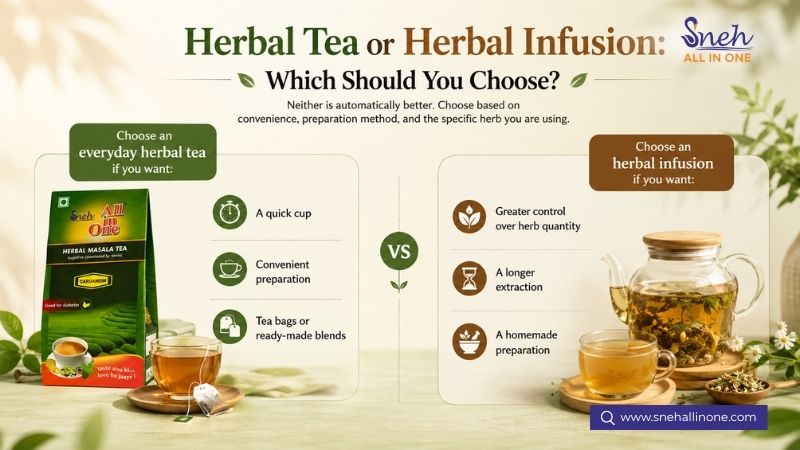
Neither is automatically better. Choose based on convenience, preparation method, and the specific herb you are using.
If you are using a commercially prepared herbal tea, there is usually no reason to change the manufacturer’s recommended brewing instructions.
For example, a ready-made herbal blend can be convenient when you want a consistent cup without measuring individual herbs each time. If you prefer convenience, pre-blended herbal tea options can save time and provide a consistent preparation without measuring individual herbs.
No. An infusion does not automatically contain more caffeine simply because it uses more herbs or steeps for longer.
Caffeine comes primarily from plants that naturally contain it, such as Camellia sinensis, which is used for green and black tea.
Therefore:
Using more caffeine-free herbs does not create caffeine.
Likewise, a longer steep cannot add caffeine that was not present in the plant material in the first place.
The ingredient list matters more than whether a product is labeled “tea” or “infusion.”
Not necessarily.
An herbal tea prepared by steeping plant material in water is also an infusion. The difference mainly concerns how the terms are being used.
No.
Strength depends on herb quantity, water volume, temperature, steeping time, and the characteristics of the plant.
No.
Many herbal beverages contain no Camellia sinensis. They can instead be made from herbs, flowers, spices, fruits, roots, or botanical blends.
No.
A longer steep can increase extraction, but it can also make some preparations overly bitter or unpleasant.
They are different preparation methods.
Infusion generally involves steeping plant material in water, while decoction typically involves simmering tougher plant parts such as certain roots or bark.
Neither the label “tea” nor “infusion” determines the benefits of a herbal beverage. The ingredients and preparation method matter more.
For example, a chamomile beverage prepared as a short steep and one prepared as a longer infusion may use the same plant.
Changing the name from “tea” to “infusion” does not automatically change what the herb contains.
The more useful questions are:
This ingredient-first approach is more useful than assuming one preparation is universally superior.
Tea usually refers to the finished beverage, while infusion refers to the process of extracting plant material in water. An herbal tea can therefore also be an infusion.
A herbal infusion is a water-based preparation made by steeping herbs in water. It is commonly used for delicate plant parts such as leaves and flowers.
They can describe the same drink, but they emphasize different aspects. Herbal tea usually describes the beverage, while infusion describes the preparation method.
Place suitable herbs in a cup or teapot, add the recommended-temperature water, cover the container, steep for the appropriate time, and strain before drinking.
A common starting point is around 1–3 tablespoons of dried herb per cup of water, but the correct amount varies by herb. Follow specific product or herbal preparation instructions whenever available.
Not automatically. An infusion can be stronger when more herbs or longer steeping are used, but strength depends on the complete preparation.
Many are naturally caffeine-free when made entirely from herbs such as chamomile or peppermint. However, blends containing green or black tea leaves can contain caffeine.
Yes. Cold infusion is another preparation method and generally requires a much longer contact time than hot infusion. It may be suitable for certain herbs and preparations.
Some roots can be infused, but tougher roots and bark are often better suited to a decoction. Always check the preparation method recommended for the specific herb.
The simplest way to remember the herbal tea vs infusion difference is to think about the beverage versus the preparation method.
Herbal tea generally describes the finished drink made from herbs and other botanical ingredients.
Infusion primarily describes the process of steeping plant material in water to extract its soluble components.
The two terms can therefore overlap. A cup of chamomile made by steeping flowers in hot water can correctly be described as both chamomile tea and a chamomile infusion.
What matters most is not the label but the ingredients, herb-to-water ratio, water temperature, steeping time, and preparation method.
Anu Sharma – Herbal Tea Specialist
Anu Sharma has more than 21 years of experience with herbal tea ingredients, traditional preparation methods, and everyday herbal beverage practices. Her content focuses on presenting herbal tea information in a practical, clear, and reader-friendly way.
Herbal teas and infusions are beverages and should not be considered substitutes for medical treatment. If you are pregnant, breastfeeding, taking medication, or managing a medical condition, consult a qualified healthcare professional before regularly consuming concentrated herbal preparations.

Author: SNEH All In One Team A good herbal kadha tea has clearly listed ingredients, suitable caffeine levels, simple brewing instructions and reliable packaging and
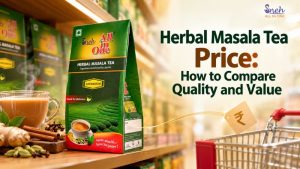
Author: SNEH All In One Editorial TeamReviewed by: SNEH All In One Herbal Tea Specialists Our SNEH All In One green-tea-based Herbal Masala Tea is
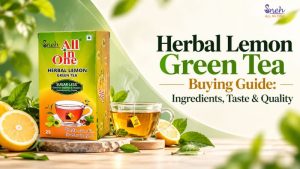
Written by: Anu Sharma – Herbal Tea Specialist with 21+ Years of ExperienceBrand: SNEH All In One – Naturally Crafted Teas Brand Disclosure: This guide